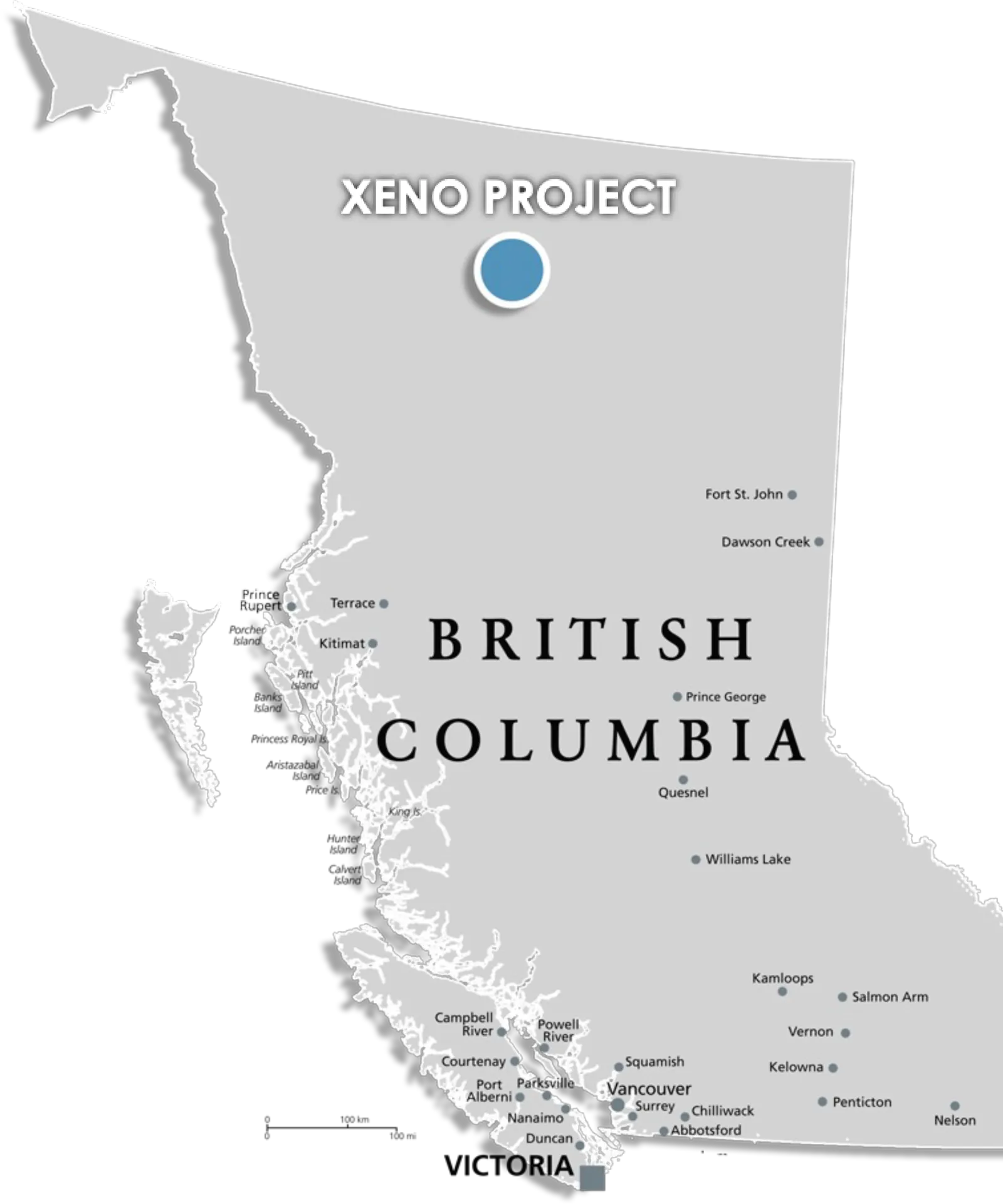
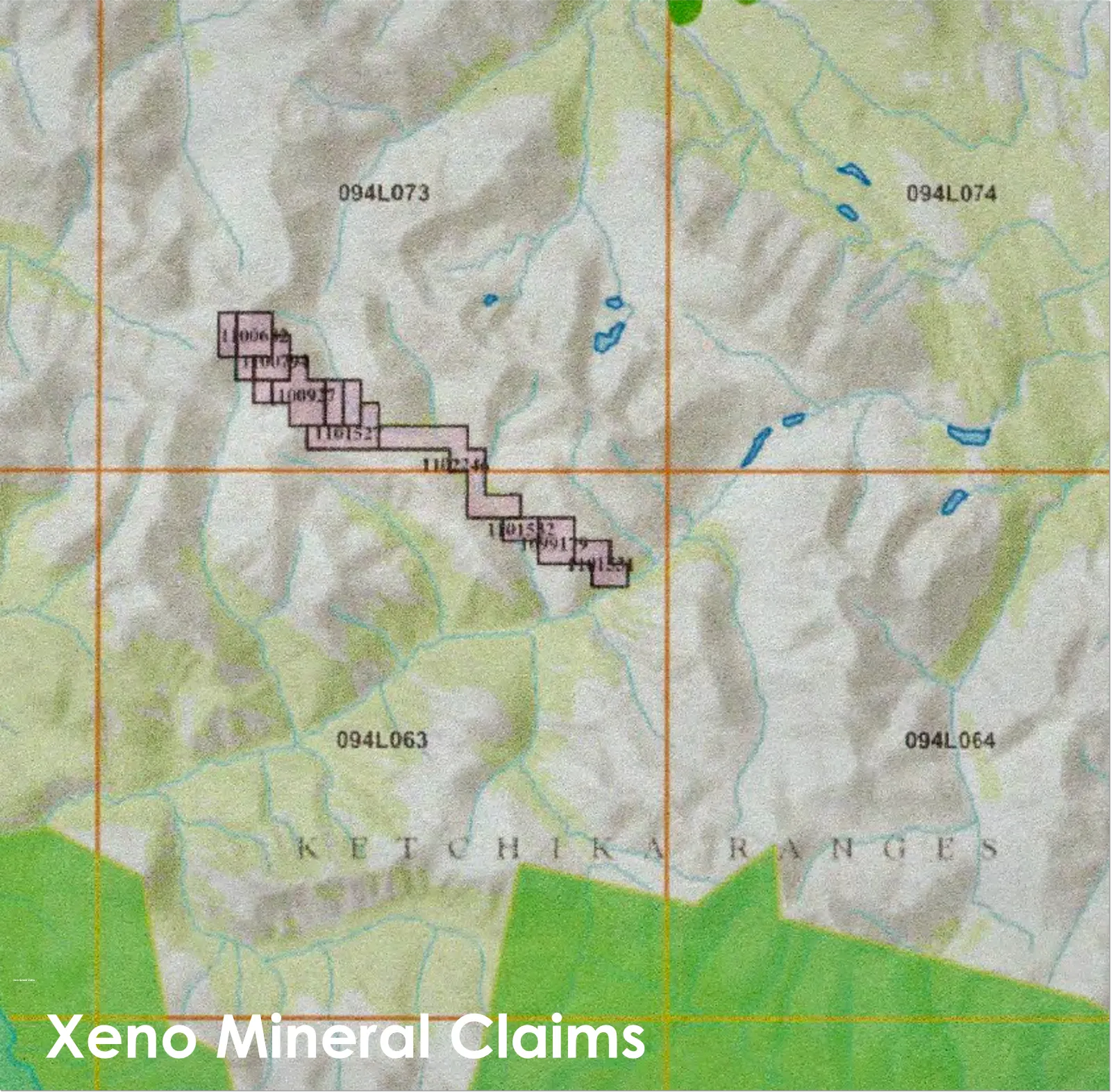
The Xeno Project, located in the Kechika Ranges of northern British Columbia, represents a rare and highly prospective rare earth element (REE)–yttrium–critical metals district with additional discovery-stage diamond potential. The project spans a multi-kilometre belt of alkaline intrusive rocks, carbonatite bodies, syenite dykes, diatreme breccias, and associated fluorite–carbonate stockworks—geological components characteristic of globally significant REE deposits.
Three decades of exploration, including detailed mapping, geochemical sampling, metallurgical tests, airborne geophysics, and modern ground surveys, have consistently confirmed high-grade REE zones, strong radiometric signatures, and the presence of kimberlite indicators including a microdiamond discovery.
Click to Enlarge
Investment Highlights
Tier-One REE System with both LREE and HREE
Across multiple campaigns (1986–2023), Xeno has returned high-grade Rare Earth Oxides (REOs) from several zones:
RAR 5 Zone (diatreme) – Average 3,747 g/t REO (2001)
RAR 3 Zone – Average 2,116 g/t REO
RAR 4 Zone – Average 1,214 g/t REO
RAR 7 Ridge Zone – Multiple high-grade REE occurrences with Y, Ce, La, Nd, Pr, Dy, Tb, Sm enrichment
These results demonstrate a robust, multi-phase mineralizing system with potential for both bulk-tonnage REE deposits and high-grade vein-style mineralization.
Structurally focused zones, possible feeder systems
Suitable for follow-up trenching and channel sampling
Geological Model
The Xeno district represents a multi-phase alkaline intrusive complex with:
Carbonatite–syenite hybrid intrusive bodies
Diatreme breccias
Fenetization halos
REE-rich fluorite-carbonate vein systems
This configuration is analogous to some of the world’s leading rare earth districts and supports the potential for both high-grade shoots and large-tonnage deposits.
Path Forward
Phase 1 — Confirmatory Work (Low-Cost)
Targeted trenching and channel sampling at RAR 5 & 7
High-resolution drone magnetics
Structural interpretation and 3D compilation
Permitting for Phase 2 drilling
Phase 2 — Initial Drill Testing
Priority Drill Holes:
RAR 5 diatreme core (REE + diamond potential)
RAR 7 ridge intrusive body (source carbonatite)
Structural intersections at RAR 3 / RAR 4
Phase 3 — Resource Definition
Systematic step-out drilling
Metallurgical testing of high-REE fluorite zones
Expansion of airborne survey coverage
SUMMARY
The Xeno Project offers:
High-grade REE mineralization confirmed repeatedly across decades
District-scale geology capable of hosting significant critical mineral deposits
Compelling geophysical signatures with untested anomalies
Unique diamond upside, derisked by previous microdiamond recovery
Clear path to drilling, with straightforward geological targets
In combination, these factors position Xeno as one of northern British Columbia’s most geologically unique and high-potential rare earth exploration projects.
Overall Interpretation
The Xeno Rar property represents a significant carbonatite–syenite–related REE system with both light and heavy REE potential, especially Yttrium, Ce, Nd, and La. REE mineralization is spatially controlled by fluorite–carbonate stockworks, phosphate alteration, and structural shearing within the Sandpile Group carbonates.