
CSE: AWCM
OTC: AWLIF
FSE: 5HV
The 11,200-acre Railroad Valley Property (“RRV” or the “Property”) is a lithium brine exploration target located in Railroad Valley, Nevada. The North Railroad Valley drainage basin is larger in size and has similar geologic potential to host a lithium brine deposit similar to the one found in Clayton Valley, Nevada, located just 125 mi to the west-southwest. Clayton Valley currently hosts the only operating lithium brine operation in North America, the Silver Peak Mine, owned by Albemarle Corporation (NYSE: ALB).
Ameriwest has defined a large lithium brine exploration target in the southwestern end of North Railroad Valley. The target is based on gravity, magnetotelluric, and seismic geophysics studies completed by Ameriwest, along with available historic oil well drilling logs and seismic data. Drilling is required next to confirm the presence of a lithium bearing brine.
No mineral resources or reserves have yet been defined on the property. Similarities of the RRV Property to Clayton Valley or the Silver Peak Mine do not guarantee exploration success at RRV.
The North Railroad Valley drainage basin is larger in size and has similar geologic potential to host a lithium brine deposit similar to the one found in Clayton Valley, Nevada, located just 125 mi to the west-southwest.
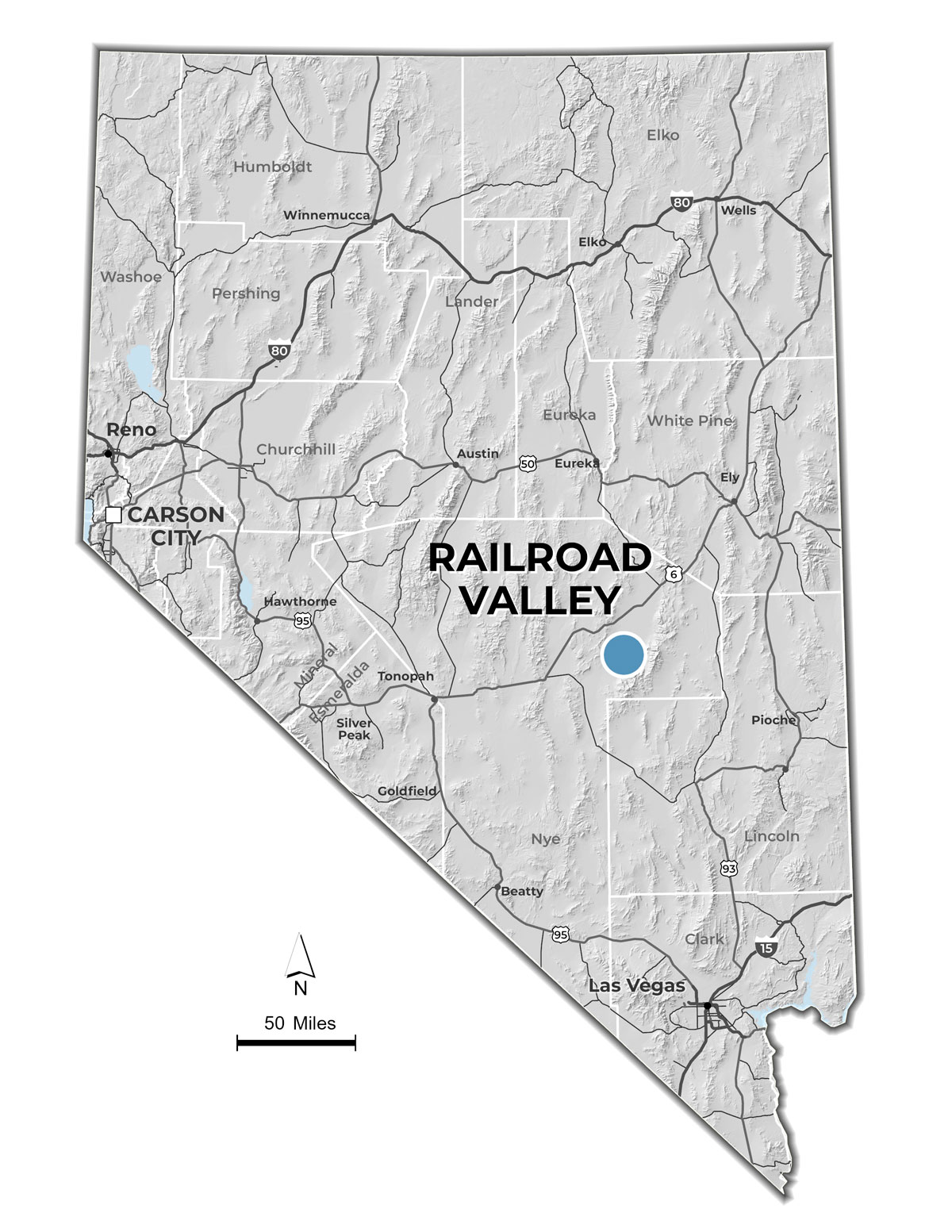
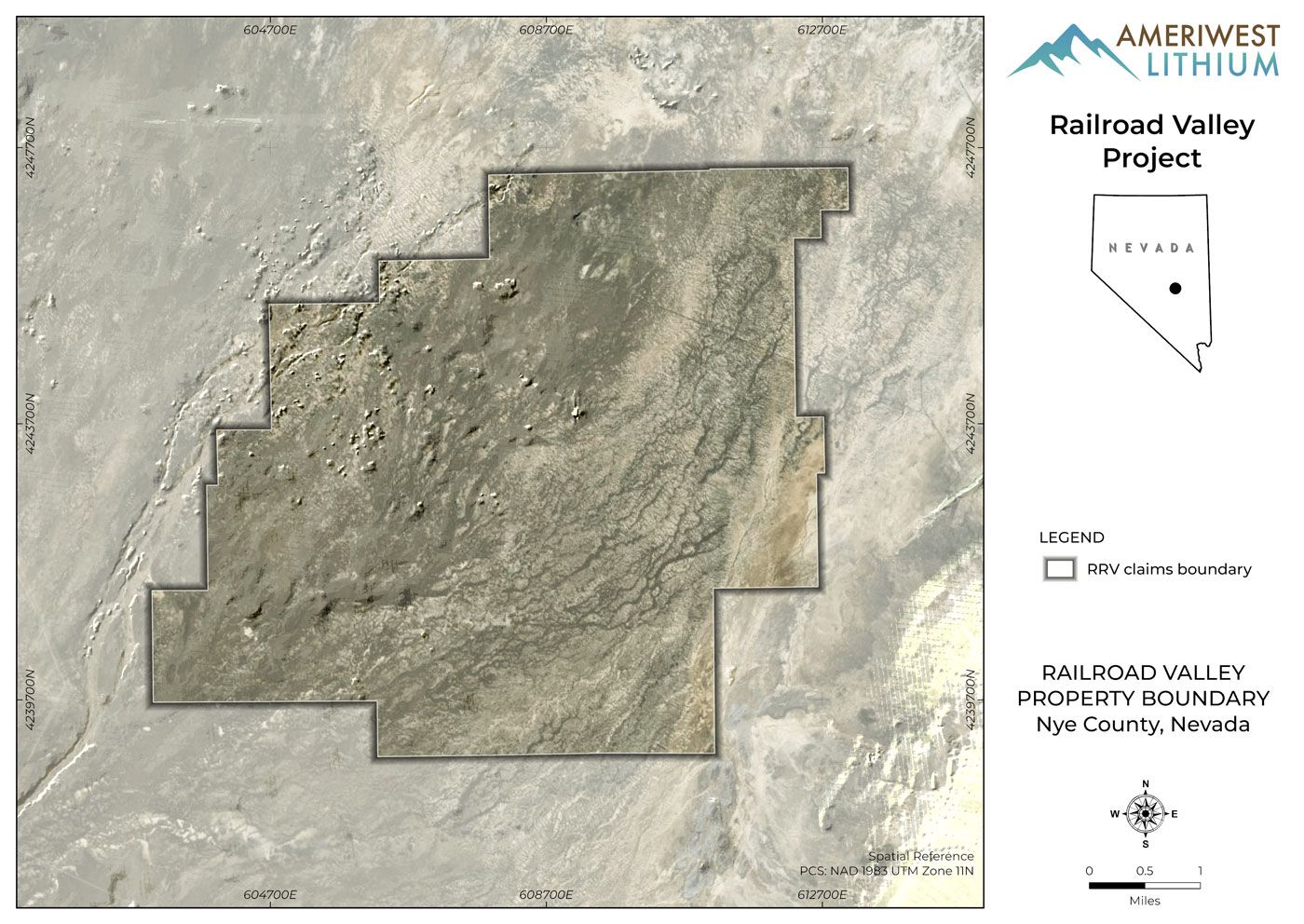
The Property is located 48 mi southwest of Ely Nevada and 125 mi south of Elko Nevada. It encompasses 563 contiguous placer claims for a total of about 11,200 acres. Ameriwest staked 556 placer claims in 2021 and 2022. In addition, the Company acquired 224 placer claims from American Battery Technology Company (OTCQB: ABML) in 2022. In 2024, the Company rationalized the claim block to its current size. The Property is 100% owned by Ameriwest, with no underlying royalties. It is in the process of being optioned to Pure Energy Minerals Inc. (TSXV:PE) as per Ameriwest’s press release dated September 4, 2024.
Paleozoic limestone and dolomite carbonate rocks are exposed in the Pancake Range on the west side of the Valley, and also in the Quinn Canyon Range and Grant Range on the east side of the Valley. Tertiary volcanic rocks, including calderas, mostly occur in the Pancake Range. Based on oil well logs, the east side of Railroad Valley is largely underlain by the Paleozoic rocks and the west side is generally underlain by the Tertiary volcanic rocks at depths up to 4,900 feet.
A major geologic feature adjacent to Railroad Valley, in the Pancake Range, is the presence of a large group of volcanic calderas, named the Hot Creek Valley Caldera Complex. This complex consists of five individual calderas. In addition, three other calderas exist on the south side of the Valley and one on the north side. The presence of these calderas is considered a positive for successful lithium exploration.
The Northern Railroad Valley hydrogeologic area covers an area of 1,375,360 acres. In comparison, Clayton Valley hydrogeologic area covers an area of 355,200 acres. Hence, the hydrogeologic area for RRV is about 3.9 times the size of the Clayton Valley area.
With regard to brine deposits, Ameriwest’s exploration is focussed on continental brine deposits. Continental brine deposits are found in underground reservoirs, typically in locations with arid climate. The brines are contained in a closed basin, with surrounding rock formation being the source of the dissolved constituents in the brine. As outlined above, continental lithium brine properties are found in certain valleys in Nevada.
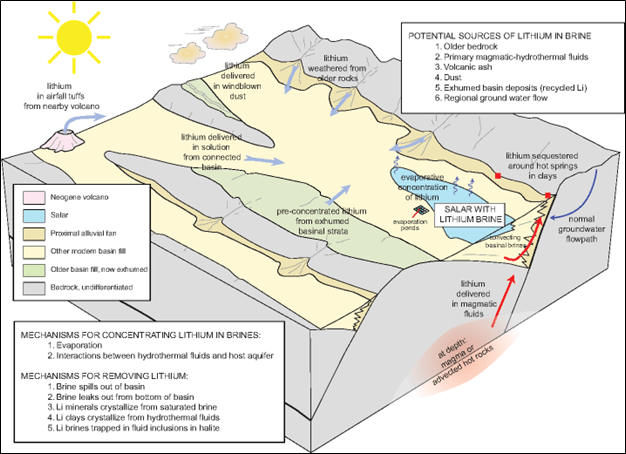
According to the United States Geological Survey (“USGS”) Open-File Report 2013-1006, Nevada hosts the best known continental lithium brine deposit in the world in Clayton Valley. Typically, in Nevada, playas or salars are found in basin valleys, representing an area of flat, dried up land (salt flat), from which water evaporated quickly. The six main characteristics of a closed basin where continental lithium brines are found are present in all of Ameriwest’s lithium brine properties. They include:
The figure above shows a closed basin that has been filled with sediments. Sources of lithium could be hot springs, magmatic fluids from below the valley, lithium weathered or eroded from adjacent mountains, and other possible sources. Typically a playa or salar is present and evaporation and precipitation of lithium in a brine solution over geologic time may build up lithium in aquifers at depth.
No surface sampling has been done on the Property. Due to the depth and geological nature of a lithium brine deposit, it was felt surface sampling would not be useful in characterising the deposit.
No mineral resources or reserves have yet been delineated on the Property that have been prepared in accordance with National Instrument 43-101 (“NI 43-101) or meet CIM standards for disclosure.
Ameriwest has received a geophysic report completed by Castillo Geophysical Limited and Legg Geophysical Inc. that analysed combined gravity, MT, seismic, and other data from studies completed by the Company or data acquired by the Company. This report recommends several locations for initial drill holes at the RRV Property with the hopes of making a lithium brine discovery. The Company plans to move forward and permit a drilling program at the RRV Property, with the goal of making a lithium brine discovery.
Geological similarity of this property to other adjacent or nearby properties does not guarantee exploration success. No mineral resources or reserves, as defined by National Instrument 43-101 standards or CIM standards have yet been delineated on the property.
The scientific and technical information regarding this project has been reviewed and approved by Robert Pease, CPG, a consultant to Ameriwest and a Qualified Person as defined in National Instrument 43-101 – Standards of Disclosure for Mineral Projects.
Statements are based on information currently available to the Company and the Company provides no assurance that actual results and future performance and achievements will meet or not differ from the expectations of management or qualified persons. All statements other than statements of historical fact are forward-looking statements. The words “believe,” “will,” “may,” “may have,” “would,” “estimate,” “continues,” “anticipates,” “intends,” “plans,” “expects,” “budget,” “scheduled,” “forecasts” and similar words are intended to identify estimates and forward-looking statements. Forward-looking statements are not guarantees and involve known and unknown risks, uncertainties and other factors which may cause the actual results, performance, or achievements of the Company to be materially different from any future results, performance or achievements expressed or implied by the forward-looking statements. Actual results and developments may be substantially different from the expectations described in the forward-looking statements for a number of reasons, many of which are not under our control, among them, exploration results, the activities of our competition, the future global economic situation, weather conditions, market prices and conditions, exchange rates, and operational and financial risks. The unexpected occurrence of one or more of the abovementioned events may significantly change the results of our operations on which we have based our estimates and forward-looking statements. Our estimates and forward-looking statements may also be influenced by, among others, legal, political, environmental or other risks that could materially affect the potential development of the Project, including risks related to outbreaks of contagious diseases or health crises impacting overall economic activity regionally or globally.