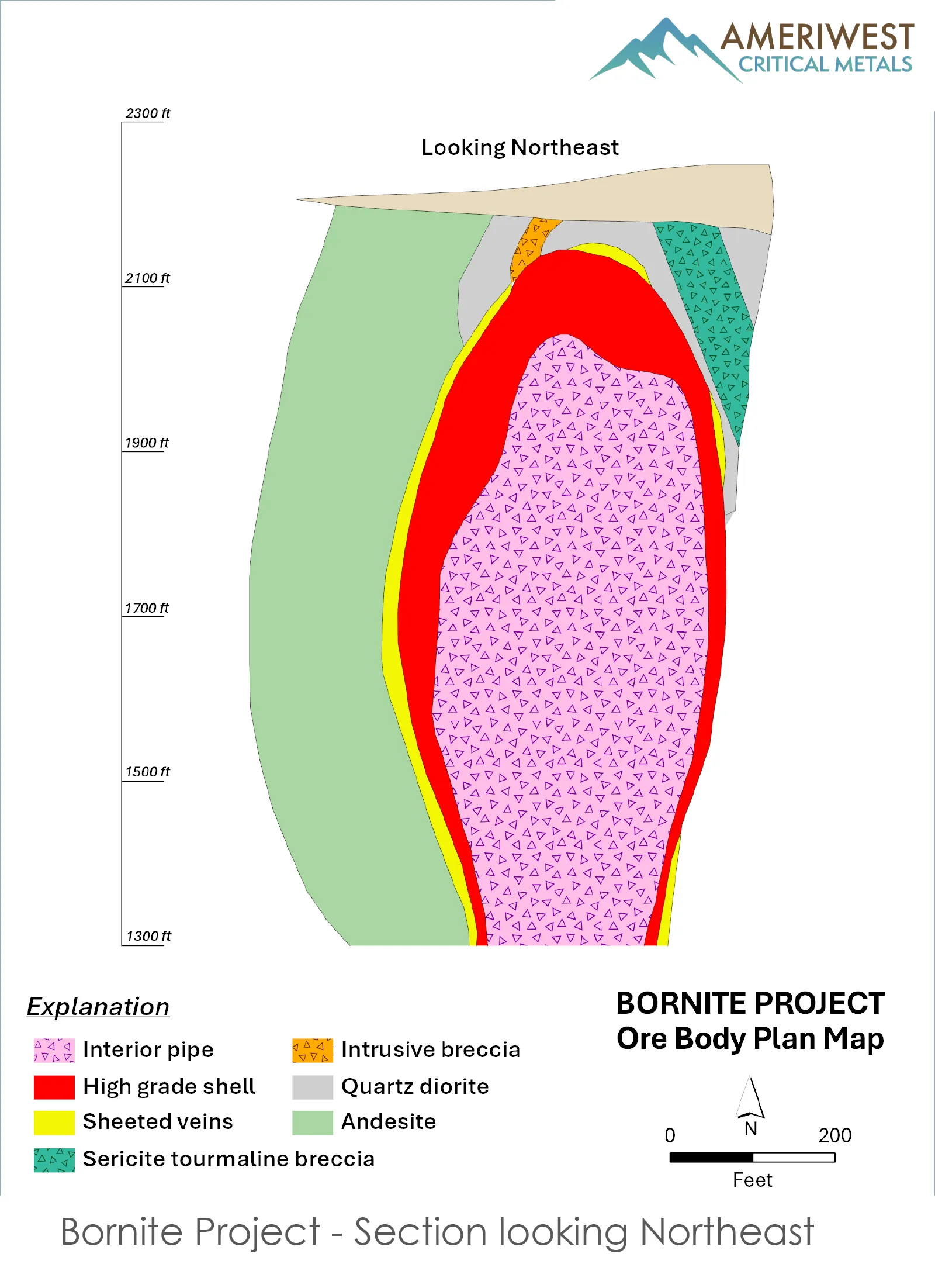
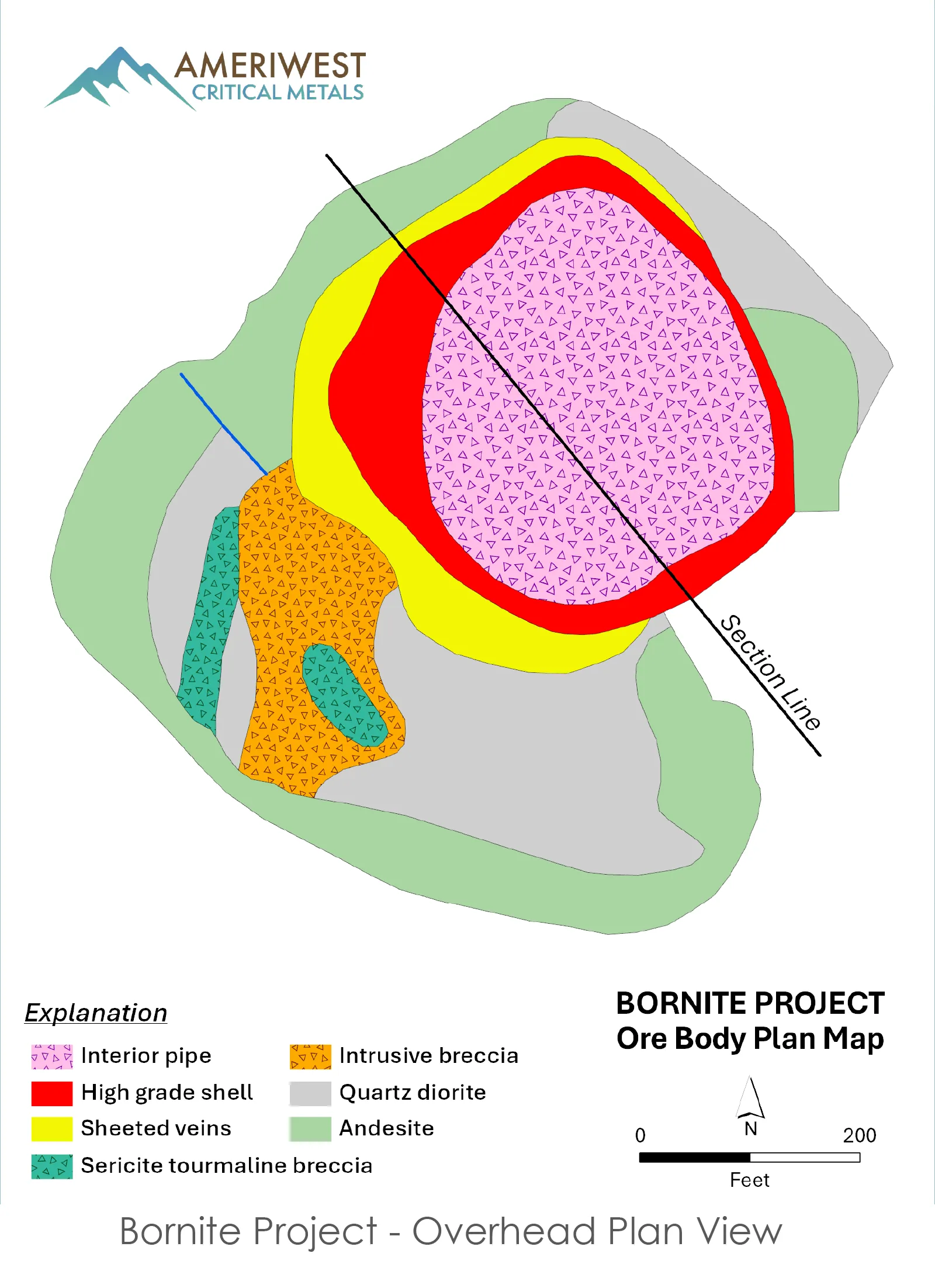
Up to 600 ft in diameter, drilled to 1,000 ft depth
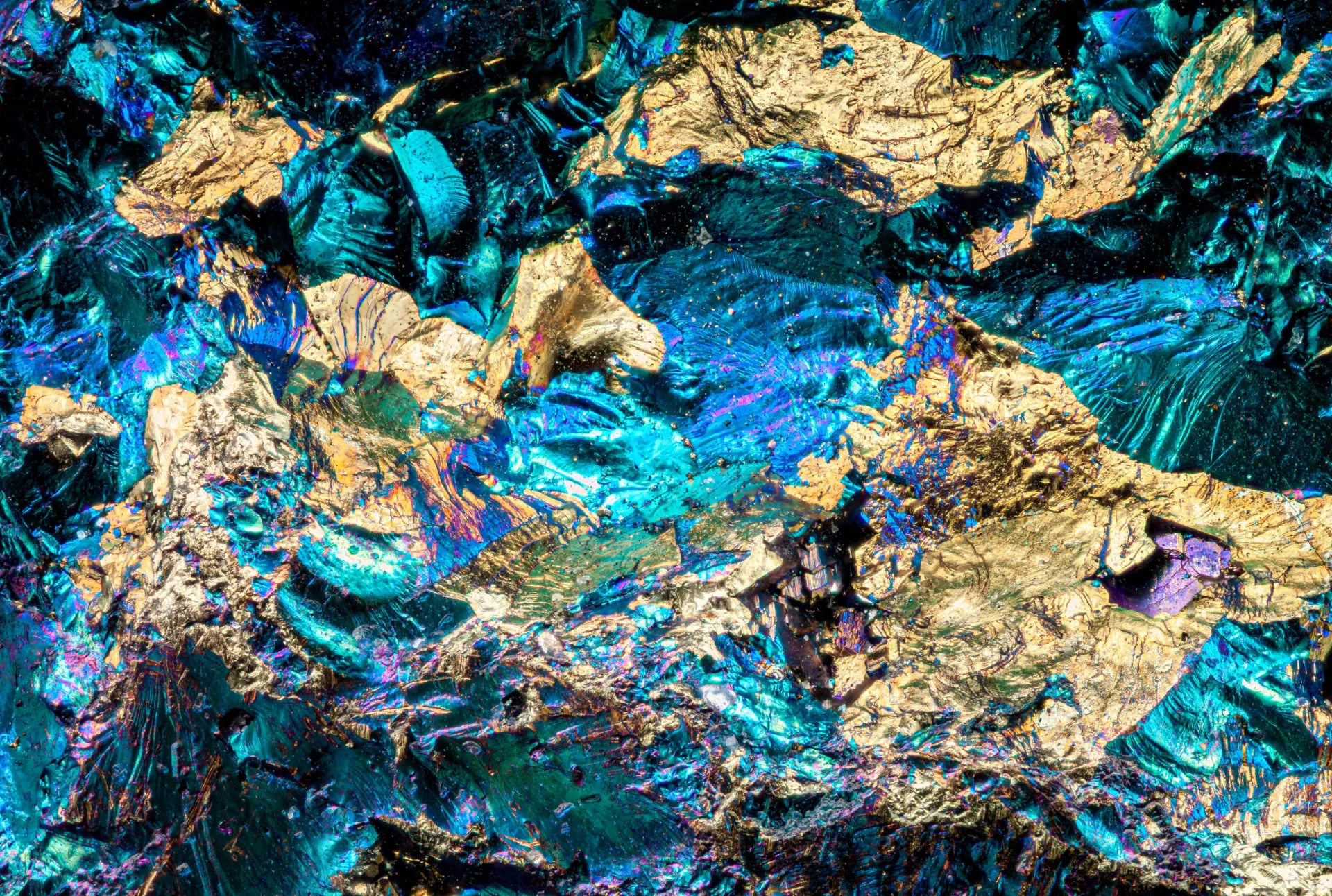
Copper minerals are primarily bornite and chalcopyrite
Higher grade mineralization is on the outer margins of the pipe, with lower grade mineralization in the pipe’s interior
Potential exists for expansion at depth, discovery of additional breccia pipes, or a porphyry system at depth.
Gold and silver are present as by-product minerals.
Click to Enlarge
Click to Enlarge
PROJECT HISTORY
1975
Discovered by Amoco Minerals.
1975/88
Drilled by Amoco Corp. and Cypress Minerals.
1989
Acquired by Plexus Resources - additional exploration.
1989/92
Plexus completed drilling, technical work, and environmental baseline studies.
1992
Internal pre-feasibility study completed by Plexus.
1993
Environmental Impact Report and Record of Decision completed by Plexus.
1993
Plexus amalgamated to become Kinross Gold.
2002
Kinross drops the property.
2004
Property re-staked by Idaho General Mines (now New Moly).
2025
Property acquired by Ameriwest after sitting idle since 1993.
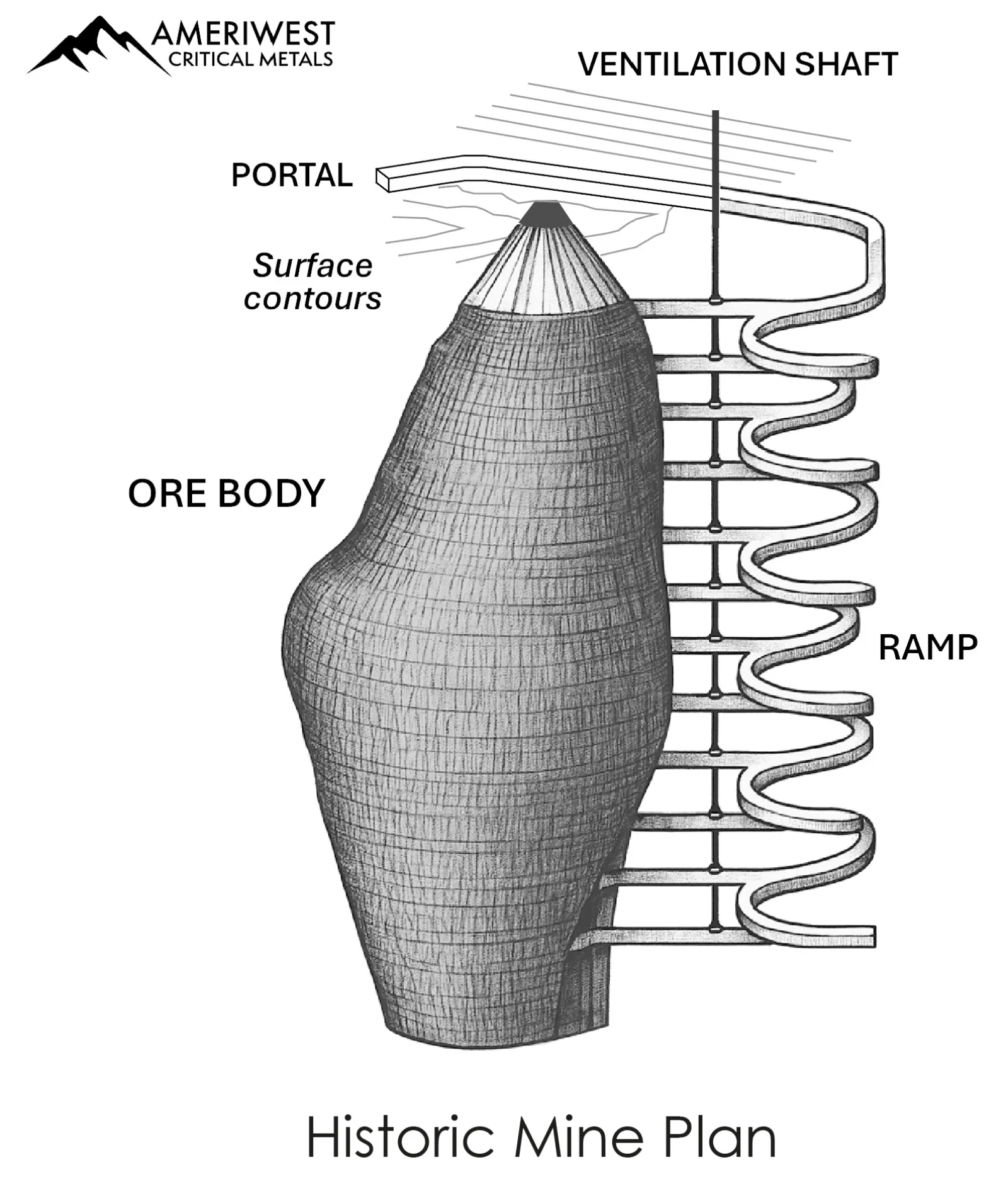
Click to Enlarge
Historic Exploration
Cypress and Amoco completed 23,142 ft of drilling between 1975 and 1988, and Plexus completed 16,419 ft of drilling in 1989 and 1990.
Plexus conducted metallurgical test work, acid-rock drainage test work, mine planning, and other technical work, and completed a Pre-feasibility Study in 1992.
Plexus quantified a resource of 3.2 million tons at 2.2% Cu, 0.017 opt Au, and 0.54 opt Au containing 138.5M lbs of Cu, 54,000 oz Au, and 1.7M oz Ag at a 0.5% Cu cut-off grade.1
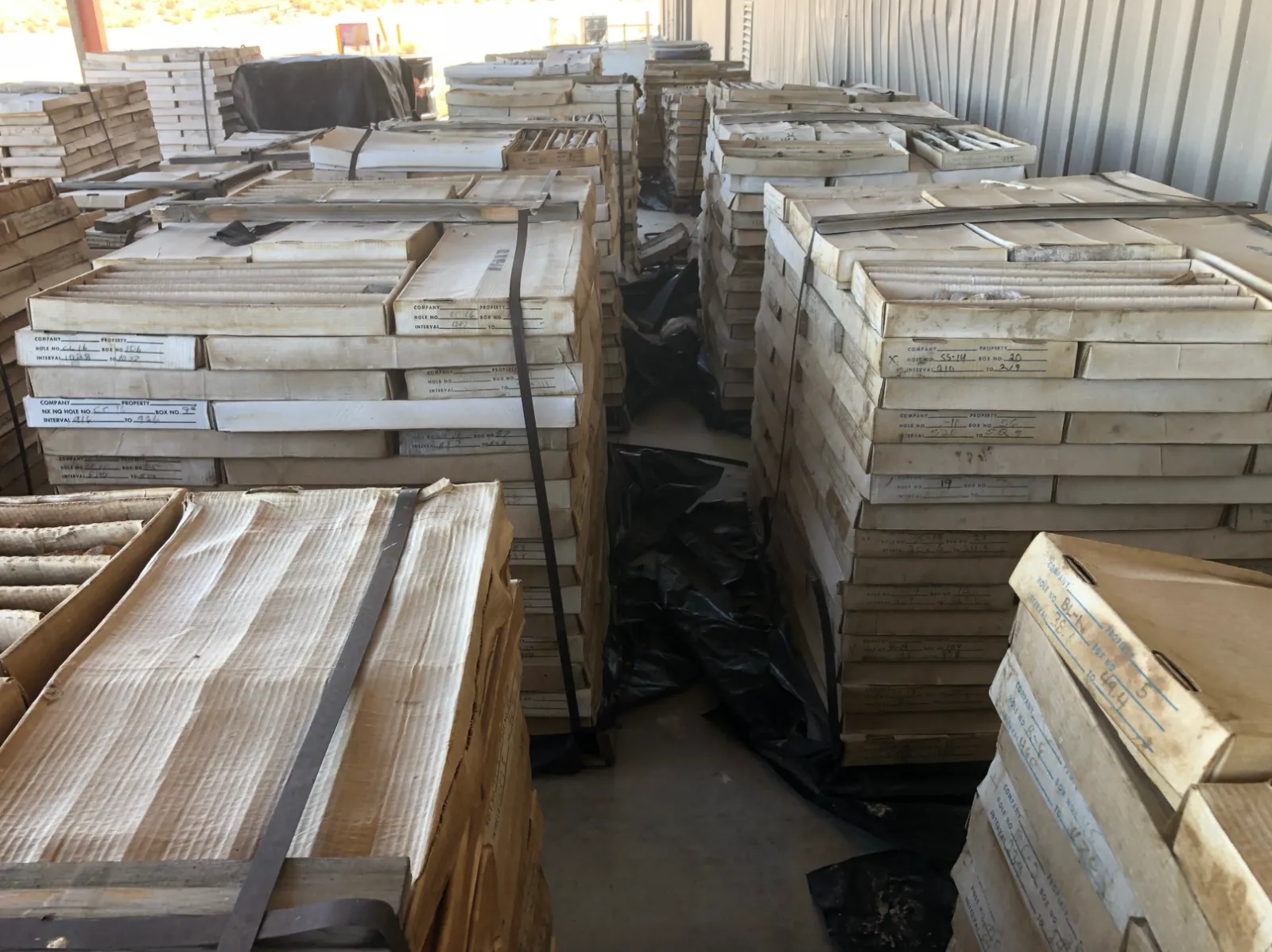
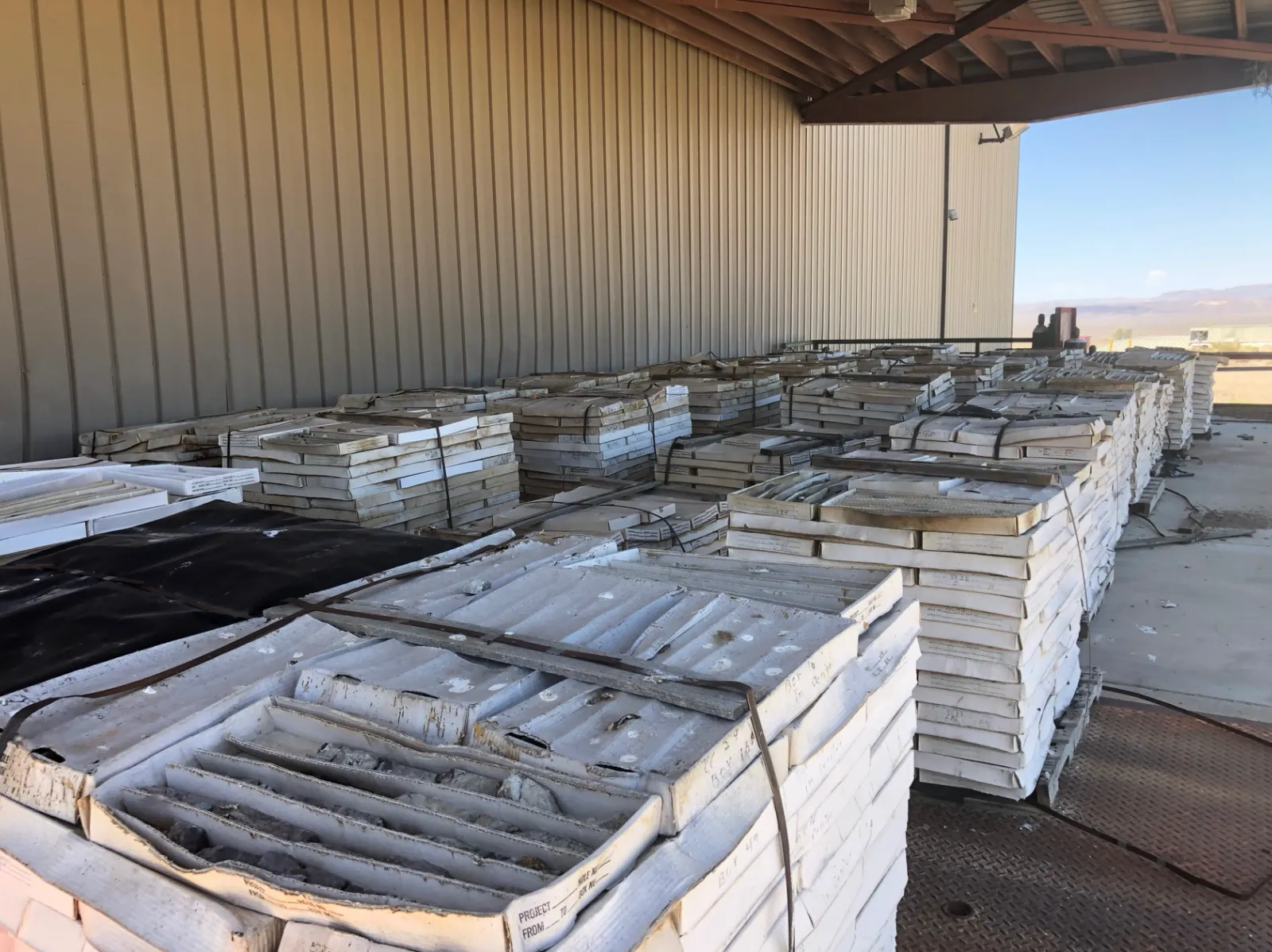
Historic Core Samples 2
Click image to enlarge
Click image to enlarge
(1) Source: Plexus 1991 Annual Report; this resource was calculated before the implementation of NI 43-101 and CIM Standards for Mineral Resources and Mineral Reserves. Ameriwest’s geologists have not verified these numbers and are treating the resource estimate as historic. No mineral resources or mineral resources that meet current standards have been identified on the property.
(2) Estimated ~30,000 feet of historic core samples to be reinterpreted as part of proposed 3D modeling program.
NEXT STEPS
1
Project Acquired
Ameriwest acquired the property from New Moly for US$100,000.
Ameriwest has granted New Moly a US$15,000 per year advance. minimum royalty and a 2% production royalty, of which 1% can be acquired at any time for US$1.0 million.
Bottom line: Low acquisition cost with significant upside potential.
2
Fast Track Workplan
Potential exists for discovery of additional breccia pipes in the area – they typically occur in clusters.
Potential exists for the discovery of a porphyry system at depth.
While Plexus planned on mining the high-grade parts of the deposit in the 1990s, potential exists for a larger lower-grade deposit if the interior core of the breccia pipe could be mined – with significant added potential to be evaluated at today’s metal prices.
3
Historic Core Samples 2
Create a 3-D geologic model from historic drill data.
Review the historic core for potential re-assaying.
Verify the location of historic drill hole collars in the field.
Design and permit a confirmation drill program (~10% of historic holes).
Conduct confirmation drilling.
Complete Lidar and geophysics.
Complete a resource estimate and Technical Report – move on to a Preliminary Economic Assessment.